
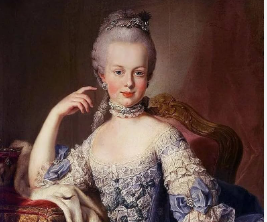
We’ve seen the images, or heard of them: Marie-Antoinette, the most famous queen of France, sporting a boat woven in her hair, complete with sails and masts. Such an extravagant hairstyle seems of a piece with all the over the top opulence of Versailles, the palace to end all palaces, and its world of theatrics and intrigue.
If such excessive splendor speaks to you as something you like to soak in, or if on the contrary you want to understand better what might seem on the face of it absurd, Memories France offers a variety of expert-guided tours of the Palace of Versailles and Marie Antoinette’s private mansion and gardens. Come along with us to to Versailles and we’ll conjure up that world for you in a walking tour you’ll never forget, be it for a full day or a half, Marie Antoinette’s Domain or the Royal Palace and gardens, or everything, trimmings included, all with special access.
But Really? A Ship?
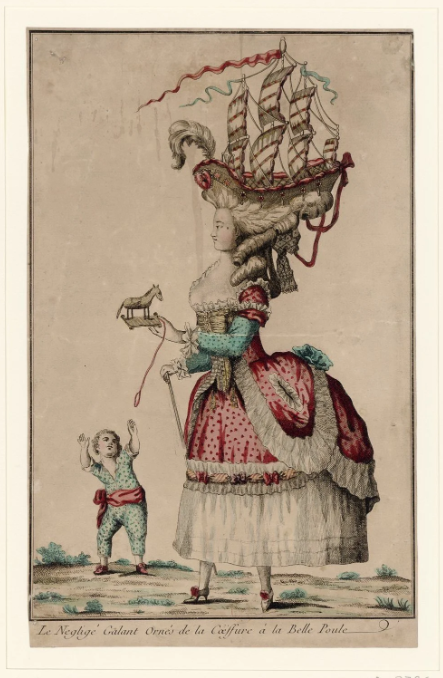
Did the queen really parade around with a ship perched on her head awash in a sea of powdered tresses, instead of a crown? Or is that a canard up there with “Let them eat cake” or dressing as a dairy maid? Find out the truth about the cake in our blog post here.
Wild legends fly about Marie Antoinette, much of it exaggeration or outright malicious gossip. Take for instance the idea that the champagne coupe was modeled on her bosom – unless it was that of Mme. de Pompadour, or was it Mme. Dubarry? Or the widespread belief that she told the starving populace they could nourish themselves on brioche. False friends and outright enemies spread the rumors, then taken up by the poison pen propaganda machine against her.
Fact is stranger than fiction, as we saw in the answer to the “Let them eat cake” question, especially when it comes to the most illustrious queen of France. But this time around, to answer the million franc question: yes it’s true. She really did.
How High Can You Go? Or, How Léonard Created the Pouf
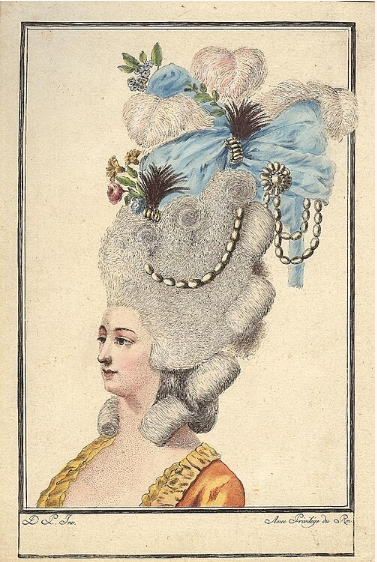
Before we get to the boat, we have to understand the “pouf” and the man behind it. Léonard Autié, came up to Paris from the provinces with little else but a comb and ambition in his pocket, determined to make his fortune in the capital. He climbed from coiffing the actresses of Paris to styling Mme Dubarry at Versailles, favorite of the king. From there he managed his way into the dressing room of the crown princess, Marie Antoinette, pleasing her with a bit of frilly coquetry in chiffon to put on her head for strolling in the gardens.
The year she was crowned at the death of Louis XV, Léonard was still working for other court ladies. The Duchess of Chartres beat Marie-Antoinette to the punch with the Pouf Sentimental worn in 1774, full on with little wax cupids, a dish of cherries, a parrot, her newborn and his servants wrapped up in 13 – 14 yards of gauze. From there the pouf took off like wildfire.
Two years later, “little ‘Toinette” as she was known, had had enough of her mother’s tut-tutting about her clothes and hair. One night, her husband summoned her to the theater all the way from Versailles into Paris. In a fit of rebellion against both Maman and the strictures of court, she he did what any 21 year old queen would do and called in her hairdresser.
She needed to affirm her new place to the people of the capital. All eyes would be on her and her alone with a hairstyle that would proclaim her a grown up ruler who made her own decisions. The man another rumor names as her crush, the gallant Swede, Count Axel de Fersen, was to be present at the theater that night, which might also have had something to do with her decision.
Léonard had been imbibing all that evening describing his state as “fairly loaded with spirituous vapors.” Yet at the queen’s summons, he pledged his muse to Bacchus and went to work. His head full of spirits –plus a few cups of coffee-- served him well. He parted, he teased, he combed and back combed and an hour later the young queen was topped with a ‘do' of three enormous white ostrich plumes, held together with a pink furbelow and a large ruby to keep it all together.
Marie-Antoinette hesitated a brief moment at the bold hairstyle that must be, she cried, a yard high. But she was delighted. When Léonard’s partner heard that the coiffure rose forty inches from the bottom of her chin, he thought they’d be sent to the Bastille. Instead of prison, their fortune was made.
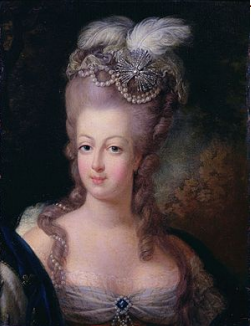
Poufs DIY : Quick and Dirty Version
Hairstyles had already been growing higher for a decade. They started on supports as modest as a banana form which morphed into the shape of a sort of high donut.
The “donut” base of wool cased crumbled cork or horsehair or down (all quite light). Then it was secured to the top of the head.
Next, scented pomatum (lemon flower, orange blossom, bergamot etc over rendered animal fat – that is itself scentless) was brushed through hair sections you would powder afterward (not just white: pink and blue powder were period-correct!) The hanks were then lifted and combed over and tucked into the hole of the donut form. After that, the donut hole would be covered with either curls - real or fake, furbelows or figurines.
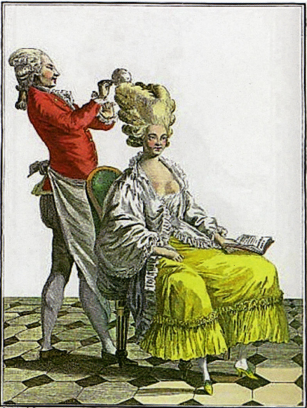
After which you would knock yourself out with decorations. Léonard’s Zephyr style had a flower garden with blooms to float in the wind, or you could go with a social statement, as when in an attempt to counter famine Louis XVI promoted potato growing, Marie-Antoinette wore a tuber in her hair. Anything goes.
And How Much Did you Say? Combien?!
The version described above was an affordable rendition, that with an abundance of pillows at night could keep its shape for days or even a week until it would need to be redone. That level of pouf could cost from 6 to 24 livres, if we judge by post-wedding hairstyle prices for the middle class (we're looking at roughly 230$ to 950$ USD today).
An opera star paid 232 livres (around 9000$ USD today) for her pouf as a wig, which is a greater outlay, but as a wig would last longer.
But the hours of styling that an upper-crust lady’s pouf would take presumed a life of leisure and abundance. One noblewoman paid her hairdresser 24,000 livres a year to have a different daily hairdo. That's between 900 000$ and 1 million USD today. To grasp the scale of this extravagance, it helps to compare it with everyday wages. In the 1780s, a skilled Parisian artisan earned roughly one to two livres per day, while unskilled labourers often made less than one. A sum of 24,000 livres therefore represented more than fifty years of wages for a skilled worker — or an entire lifetime and beyond for many others.
Marie Antoinette also changed hairstyles everyday. For hard numbers, we have the receipt of 4,063 livres worth of hair products from Léonard in the single year of 1787. That comes to almost 34,000 dollars today, on products alone.
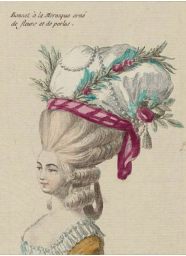
Splendors and Miseries of the Pouf
A hairstyle like the Pouf La Belle Poule could reach up to 60 cm (two feet) high and was incredibly heavy, often weighing several pounds due to layers of hair, padding, wires, and ornaments.
Sleeping: To preserve the pouf, ladies would sleep in a semi-upright position, often leaning on specially designed pillows or reclining chairs. It was impossible to lie flat without destroying the elaborate structure. Some accounts even mention small stools or cushions to keep the head elevated at night.
Carriages: Fitting into a horse-drawn carriage was no small feat either. The height and width of the pouf meant that doors were sometimes hard to navigate, and careful positioning was needed to avoid crushing the hairstyle. Some carriages had to be modified, ladies would crouch, and courtiers would help adjust the hair before departure.
Hygiene and Comfort: Wearing such an elaborate style for days at a time brought hygiene challenges. Hair could become infested with lice or mites if not meticulously maintained. Women often avoided washing their hair too frequently, using powders and scents to mask odors instead. The weight and structure also caused neck strain and headaches, making long periods of wear uncomfortable.
In short, the pouf was a work of art—but one that demanded patience, endurance, and no small amount of discomfort. Wearing one was a clear signal of status: only those with wealth, servants, and leisure could truly manage it.
Léonard loved to tell the story of the Duchess of Chartres, sporting his Pouf Sentimental one night at the theater. Its ornaments got all tangled up into a candelabra when she stood up, evicting parrot and cherries. These were caught by her father, before they fell on the seats below to make a laughing stock of his daughter.
For Marie-Antoinette’s night at the theater, servants had to carefully de-plume the queen’s do for her to be able to enter the carriage to take her to Paris -- and, they say, had to leave them there for her return.
After the style took off, theater audiences couldn’t see shows for the forest of pomaded tresses. As a result the Paris Opera House’s director decreed only modest poufs would be admitted, under threat of arrest by the forces of order.
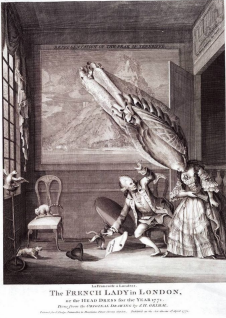
The Truth of the Story
So yes, the Queen of France rocked a fully rigged frigate complete with cannon (and even cannon smoke!) and mast, anchored in the harbor of her pomaded locks, her natural waves imitating the tides that would bring it out to sea again.
But why? The style was christened Pouf à la Belle Poule and was worn as a political and patriotic statement, not merely as a fashion whim.
Here’s why it mattered:
A celebration of a French naval victory
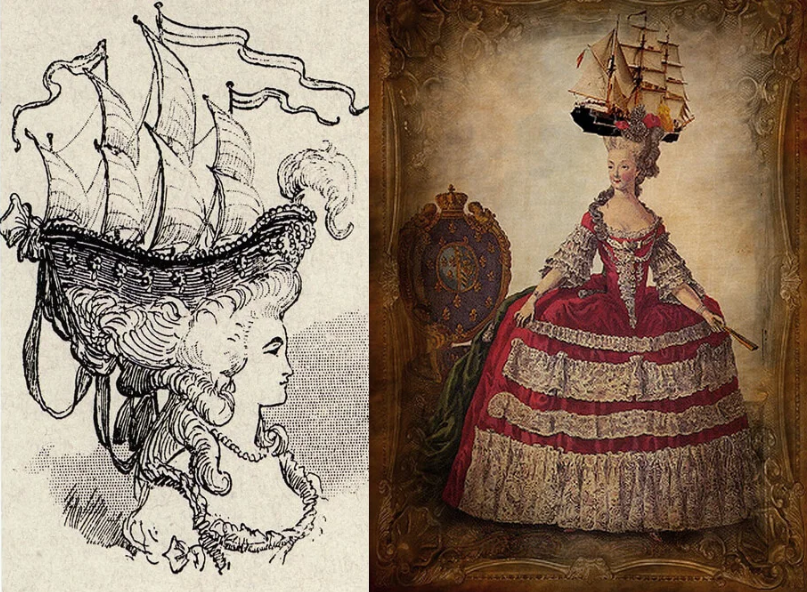
In 1778, during the American War of Independence, the French frigate La Belle Poule defeated a British ship, HMS Arethusa. Though militarily modest, the victory was hugely symbolic: it boosted French pride and signaled France’s growing challenge to British naval dominance.
At a time when public opinion mattered more than ever, the win caused a sensation in Paris.
Fashion as propaganda
By wearing it, the Queen publicly celebrated France’s success, aligned herself with national pride and military strength and showed support for France’s involvement in the American cause
In essence, her hair became royal propaganda—a walking headline.
Marie-Antoinette’s most elaborate poufs were never just about glamour—they were visual commentary on current events, royal propaganda, or allegorical statements. They allowed her to engage with politics and public sentiment without uttering a word, all while dazzling the court.
Come with Us to Learn More!
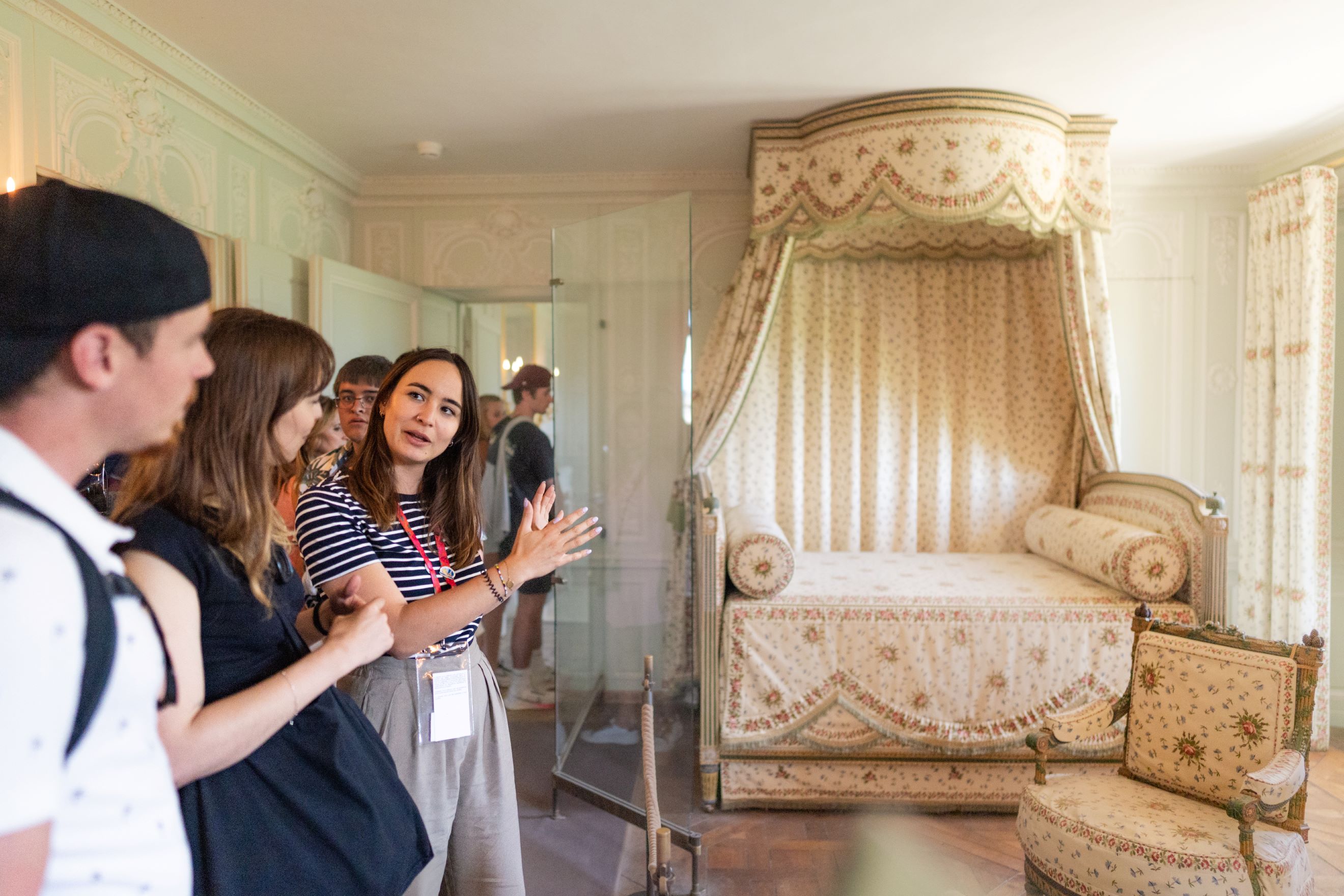
Thus not legend but fact, the hairstyle serves as a window into an entire culture. That window lets us look above all into the Versailles way of life, with all its theatrics and spectacle.
Step back in time into the world of excess and extravagance that gave us the Pouf à la Belle Poule. Explore our Versailles tours and let our expert tour guides bring the stories behind the spectacle to life!
From Marie Antoinette’s Petit Trianon and ornamental farm to the breathtaking fountains of the gardens to the unending gold of the palace itself, Memories France offers a Versailles experience for every taste, for those fully under its spell and those dubious of its lavish extremes. All of these tours are with a guide deeply versed in Versailles’ history, not just the Hall of Mirrors, but its behind the scenes lore as well, to show you what life was like when towering hair rose to the height of fashion.
Thank you so much for taking the time to read our blog! We are a small Paris-based tour company that prioritises a boutique personal experience where we can share our passion for our heritage and community with every individual that joins us. If you'd like to take a tour then head over to our website for an unforgettable trip to the city of lights. Also, check out our social media @memories.france for everything you could need to know for coming to Paris: from how to use the metro to coffee shops closest to each major monument, there is something for everyone!
Angelissa, Siobhan & the Memories France Family
If you're looking for more tips, itineraries, and insights into Paris, check out our social media!
Like what you see? Read our other blogs here!
- Black History Month in Paris: Jazz, Montmartre and the Legend of BricktopBlack History Month is the perfect moment to explore the Black artists, musicians and writers who helped shape modern Paris. From the jazz-filled streets of 1920s Montmartre to the legendary cabaret Bricktop’s, discover the story of Ada “Bricktop” Smith and the vibrant community that made the French capital a haven for creativity, freedom and nightlife.
- Things to Do in Paris When It Rains: Museums, Covered Passages & Cozy CafésRainy days in Paris don’t have to mean hiding indoors — in fact, they can be some of the most atmospheric moments to explore the city. From world-class museums and overlooked hidden gems, from historic covered passages to cosy cafés with fogged-up windows, Paris shines even when the skies are grey. Whether you’re visiting in winter or early spring, this guide is packed with practical tips and local favourites to help you stay dry, warm, and inspired — and to enjoy Paris at its most intimate, reflective, and quietly beautiful.
- A Local’s Guide to the Covered Passages of ParisStep off Paris’s busy streets and into its hidden arcades — the covered passages. Built in the 19th century, these elegant glass-roofed galleries were once the city’s chic shopping streets, filled with boutiques, cafés, and charm. Today, they’re perfect for wandering, discovering artisan shops, and enjoying quiet meanderings away from the crowds. From Galerie Vivienne to Passage Choiseuil, each passage has its own story and treasures. This guide will show you the must-see passages, hidden gems, and local tips so you can explore Paris like a true insider.
- Did Marie Antoinette Really Wear a Boat In Her Hair?Marie-Antoinette’s hairstyles were far more than extravagant fashion statements. Towering poufs crowned with ships, symbols, and allegories turned her hair into a stage for politics, patriotism, and royal image-making. From naval victories to coded messages about power, fertility, and loyalty, the Queen’s hair told stories that eighteenth-century audiences knew exactly how to read—long before scandal reduced them to caricature.
- Secret Christmas Walks in Paris: 6 Magical Neighbourhoods to Explore this WinterParis sparkles at Christmas — but the real magic lies beyond the big boulevards. Let us take you into the authentic neighbourhoods of our city and show you the charming, local side of Paris during the winter holiday season. Bundle up, leave the tourists behind and follow us!